Contents
If you're an expat in Qatar, retirement planning largely depends on your own savings and financial plan. Qatar's tax-free salaries make it one of the best places in the world to build wealth, but that advantage only compounds if you put a structure around it. This guide walks you through the key inputs, available tools, and factors that can shift your retirement target up or down.
Who is eligible for a pension in Qatar?
Only Qatari nationals are eligible for a state pension in Qatar. Qatar's state pension is administered by the General Retirement and Social Insurance Authority (GRSIA/Daman). The minimum retirement age in Qatar is 50 for men and 45 for women, with 25 years of qualifying service required.
For everyone else, the picture is different. Expats make up around 88.4% of Qatar's total population, and the national pension system covers none of them. The retirement age in Qatar for foreigners is not defined by law. It's the age at which your savings can sustain you. That makes private planning the only real option.
One benefit that applies to all workers regardless of nationality is the end-of-service benefits — a lump sum paid by employers when you leave after at least 1 year. It's worth factoring into your overall picture, but it's a one-time payout, not a pension.
How to calculate the final settlement in Qatar?
Step 1: Estimate your monthly expenses in retirement
Think about where you'll live and how you'll spend your time. If you plan to stay in Doha, this retirement planning guide uses QAR 18,000/month as a realistic baseline — covering housing, leisure, and regular international travel. If you plan to retire abroad, your costs may be lower, though that depends heavily on where you go.
Step 2: Multiply by years in retirement
Qatar's life expectancy is currently around 80–85 years. If you retire at 60, you're planning for roughly 25 years of expenses. So:
QAR 18,000 × 12 months × 25 years = QAR 5.4 million
That's your base figure before inflation.
Step 3: Adjust for inflation
Qatar's inflation rate averaged 1.1% in 2025. That sounds modest, but compounded over 25 years, it meaningfully erodes what your money can buy. Applying that rate to the QAR 5.4 million base yields a real target of approximately QAR 6.75 million.
Step 4: Work out your monthly savings target
This is where compound growth comes in. Historically, a diversified investment portfolio — mixing equities, bonds, and real assets — has returned somewhere between 5% and 7% annually over the long run, with 6% used as a common moderate planning assumption. If you save QAR 8,000/month from age 35 to 60 at a 6% annual return, you'd accumulate close to QAR 6.5 million — nearly enough to hit the inflation-adjusted target.
Step 5: Subtract what you already have
Deduct any end-of-service benefits you expect to receive, existing savings, or investment balances. The remaining gap is what your monthly contributions need to close.
What retirement planning tools are available for Qatar residents?
Depending on your status and how hands-on you want to be, several options are worth knowing about:
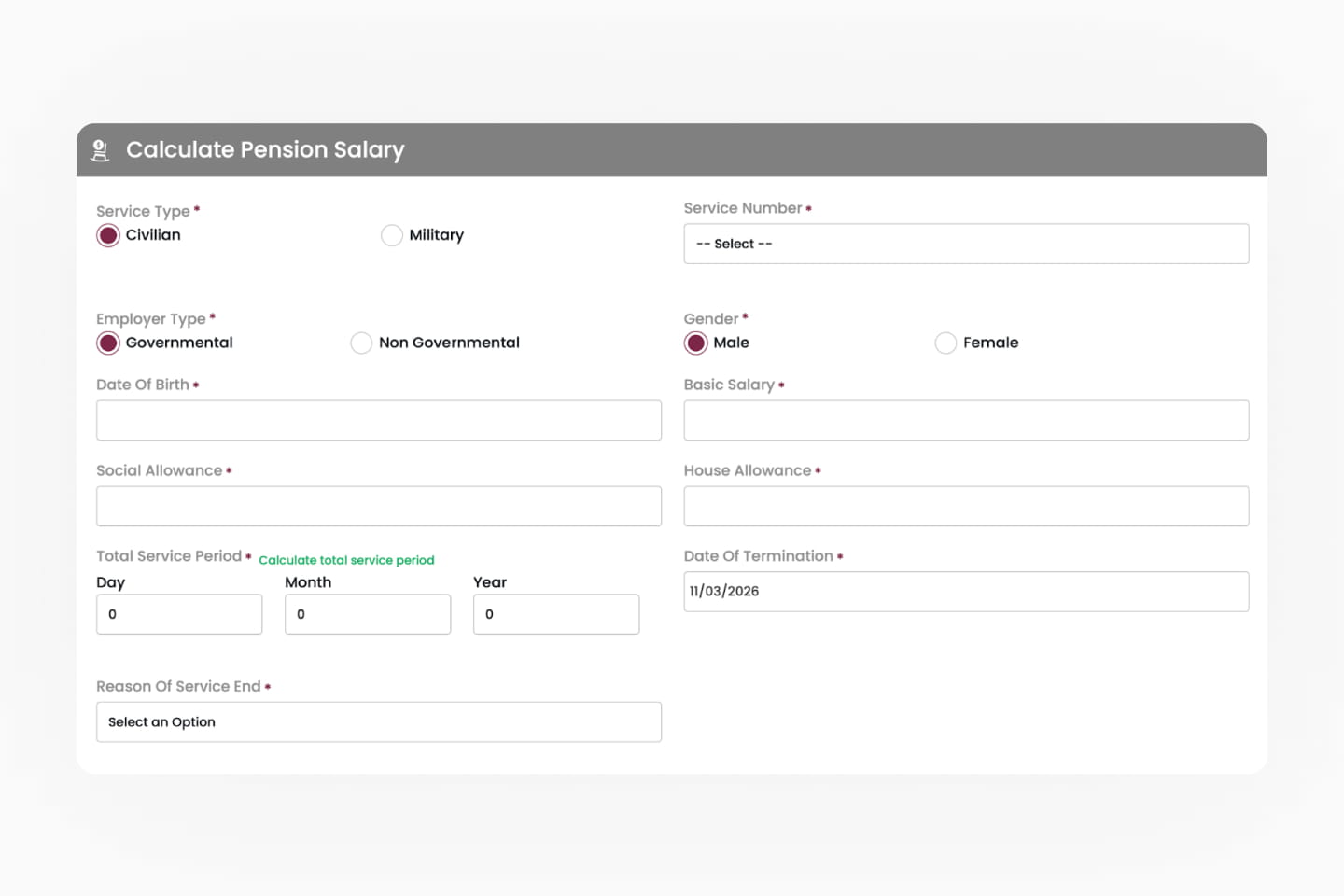
- GRSIA pension calculator — Available to Qatari nationals only. Estimates your state pension based on length of service and salary history
- Retirement insurance — Retirement insurance allows flexible contributions and protects your savings during unforeseen events — illness, disability, or death — while your fund is still growing
If you plan to retire outside Qatar, run your calculations in both QAR and your target currency. Exchange rate movements can significantly affect the real value of savings held in riyals.
Factors that can shift your retirement readiness
Several variables can move your number — up or down — more than most people account for:
-
When you start. Beginning at 40 instead of 30 can roughly halve your projected total, all else equal. The earlier you start, the less you need to contribute each month to reach the same target
-
End-of-service benefits. This lump sum can make a meaningful dent in your target — especially after 10+ years with one employer. Factor it in, but treat it as a bonus, not a foundation
-
Healthcare costs. Healthcare needs typically increase with age. If you plan to stay in Qatar, private health coverage will be essential. Learn more about working and financial life in Qatar
-
Tax obligations abroad. Expats may still owe income or capital gains tax in their home country, even while living tax-free in Qatar. This varies by nationality and is worth reviewing with a tax advisor well before retirement
-
Where you retire. Costs vary widely by destination. Countries like Portugal, Malaysia, or Thailand are popular with retirees precisely because day-to-day expenses — groceries, dining, transport — tend to be significantly lower than in Doha. The trade-off is that your savings are in riyals, and exchange rates can work against you over a 20–30-year retirement. Healthcare quality and accessibility also differ considerably from what you're used to in Qatar. It's worth researching both thoroughly before committing to a location
FAQ
What is the 7% rule for retirement?
How much will a QAR 100,000 pension pay per month?
How do I calculate how much I need in retirement?
What is the retirement age for expats in Qatar?
What are the biggest retirement mistakes expats make in Qatar?