
Expats make up over 88% of the country’s population, but is it possible to retire in Qatar as an expat? While the structured state pension is reserved only for nationals, foreign residents can live out their retirement in the country with the support of end-of-service benefits, savings, and careful visa and pension planning. Here’s every question about retirement in Qatar answered — from the minimum years of service for nationals to visas for expats who reach their retirement age.
What is the retirement age in Qatar?
The retirement age for nationals of Qatar is 60 years in accordance with the Social Insurance Law 1/2022. Furthermore, a person can retire earlier if they've made at least 25 years of Social Security contributions and reached 20 years of active service.
The 60-year benchmark is for both males and females. The mandatory retirement age remains 60 for most government employees as well, but it may be waived in exceptional cases for senior and specialist positions by ministerial decision. For early pensions, the minimum age is set to 50.
What is the retirement age in Qatar for foreigners?
Foreign workers do not have a specific retirement age. Under Qatar's Labor Law No.14, there is no fixed time after which a foreign worker may be prohibited from working. In reality, residency visas for foreigners become more cumbersome to renew once they reach 60 years of age, due to additional approvals required by the Ministry of Interior from the employer, medical checks, and the fact that work visas aren’t issued above this age limit.
Private-sector contracts are subject to standard contract terms until age 60. Then, the renewal process varies from case to case and is often tied to the employee’s job, good health, and the employer's justified reasons for retaining the worker.
What is the retirement age in Qatar for expats?
There's no legal retirement age for expats, but after age 60, renewing residency becomes more difficult. Therefore, the expat retirement age is not a pension trigger.
What is the maximum age to work in Qatar?
Technically, there is no maximum age for working in Qatar. But after a worker turns 60, the employer must file an application with the Ministry of Interior for continued service, stating the reasons for the request.
The most common recipients of approvals are doctors, engineers, academics, consultants, and other specialists whose skills are difficult to replace.
Can you work in Qatar over 60?
Yes, you can work in Qatar if you’re older than 60. But there are stipulations. Any employer retaining or employing an individual aged 60 or over must provide clear reasons for doing so. The Ministry of Interior considers:
-
Skill level of the worker
-
Scarcity of the worker’s skills
-
Medical fitness: Generally, a health check is necessary
-
Employer's business rationale
-
Duration of the desired extension: Usually 1 to 2 years at a time
Sectors like healthcare, higher education, oil and gas, and engineering consulting see the most approvals, as they rely on specialist know-how.
How to qualify for a pension in Qatar?
The General Retirement and Social Insurance Authority (GRSIA) administers the state pension. To qualify, the Qatari national must be 60 years old and have at least 25 years of social security contributions.
Pension calculations vary between employers. In most cases, a pension is calculated at 5% of the average salary over the past 5 years, multiplied by years of service. The annuity can't exceed the employee’s average salary.
Contributions are divided between the employee (Qatari national) and the employer:
-
Employee: 7% of salary
-
Employer: 14% of salary
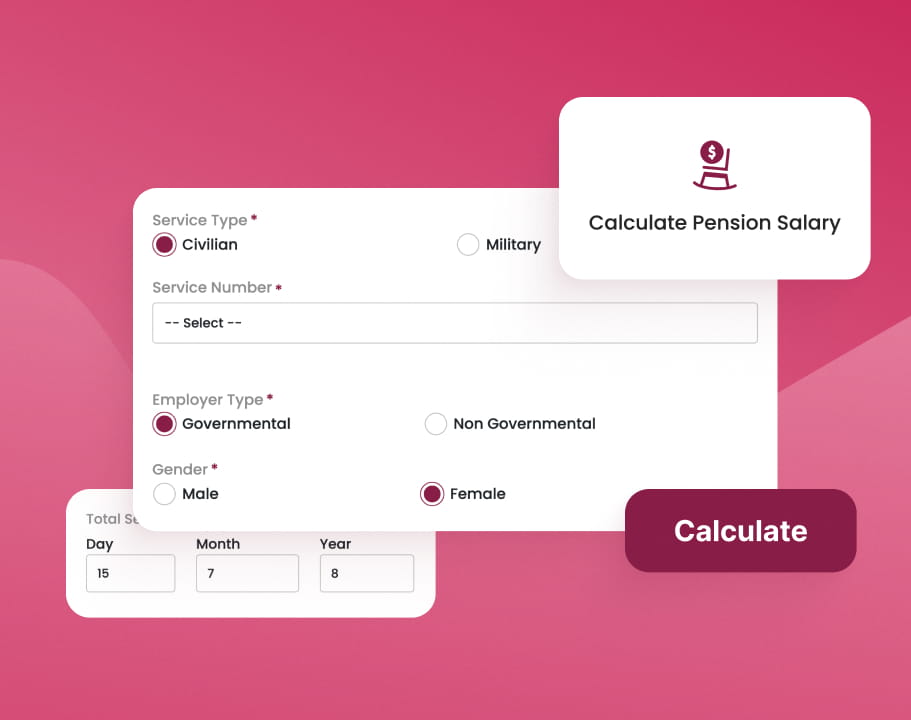
To calculate your potential pension or service period, use the official GRSIA calculators.
Can you qualify for a pension in Qatar as an expat?
No. Qatar's state pension scheme is limited to Qatari citizens. Expats are not registered with the General Retirement and Social Insurance Authority and do not pay into or receive a Qatari pension. What they get is the end-of-service gratuity (EOSG) as per Article 54 of the Labour Law.
The end-of-service gratuity is a one-off job termination payment made at the end of the employment contract if the worker has served a minimum of 12 months. The statutory minimum is 3 weeks of basic salary per year of service, with many companies providing higher service benefits, particularly for those who have worked for them longer.
How much is a pension in Qatar?
Nationals will receive a pension based on their final salary and years of contribution, as explained above. For expats, end-of-service gratuity is the equivalent benefit. They typically receive at least 3 weeks of basic salary for every year of service.
For example, an employee with a basic salary of QAR 15,000 per month and 15 years of service would be entitled to approximately QAR 167,000 at the end of service.
Usually, expats supplement this with retirement savings they make in their own countries or with foreign pension plans. Alternatively, many invest in private retirement insurance, which allows them to contribute a set amount each month, protects them against unpredictable events such as illness and disability, and provides a regular income once the retirement age is reached.
Can you retire in Qatar as an expat?
Yes, you can technically live in Qatar during your retirement as an expat, but there needs to be a plan. There is no dedicated retirement visa in Qatar, so those who wish to stay must choose one of three common ways:
-
A residence permit for family members, sponsored by an adult child who works in Qatar
-
Being a resident of a property with a value of QAR 730,000 or above (Golden Visa)
-
Permanent residency, which is much more demanding
For expats who want to stay long-term after retirement, the most popular way is through the property pathway. It does not expire and is renewable as long as the property is maintained.
Can you live in Qatar permanently?
Permanent residency is covered by Law No. 10/2018. Up to 100 permits are granted per year by the Ministry of Interior, based on the following criteria:
-
For those born outside of Qatar, the residency requirement is 20 years
-
For those born in Qatar, the residency requirement is 10 years
-
Ethical conduct
-
Good knowledge of Arabic
-
Enough income to support family members
The holder will benefit from free public health care, free state education, and can own certain assets without a Qatari partner.