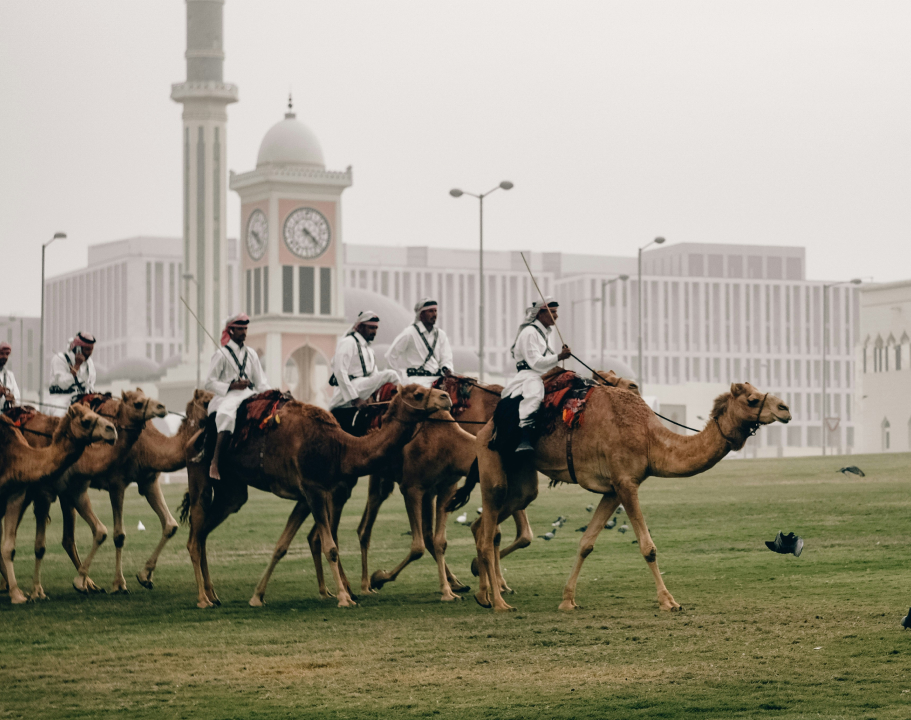
The temperature in Qatar during the summer months often exceeds 40°C, so knowing the rules for seasonal work is not a matter of compliance but of safety. The Qatari government has introduced clear regulations to ensure that workers are not exposed to heat-related risks, which affect not only construction timelines but also delivery services. Here’s everything about protections for working outside in the summer, including the midday work ban and the heat stress flag system in Qatar.
What are regular working hours in Qatar?
The Qatar law states that no employee shall work more than 8 hours a day or 48 hours per week. Any work that exceeds this limit is considered overtime, and the employee must be paid a higher rate.
The exception is Ramadan, when the law states that regular work shall not exceed 6 hours a day or 36 hours per week. There are some exemptions, though, in both of these circumstances, so check out Articles 35–40 for more information.
Are there any summer working restrictions in Qatar?
Every year, Qatar imposes severe summer working limits on outdoor and open-air workplaces between June 1 and September 15, also known as the midday work ban. According to Ministerial Decision No. 17 of 2021, work is not allowed between 10 AM and 3:30 PM daily in any place that is under direct sunlight or where the workers are generally exposed to high humidity and heat.
Violating these restrictions has serious consequences. The Ministry of Labor can enforce the partial or full closure of work sites for non-compliance. Furthermore, companies can face severe financial penalties and even legal action for breaches of contracts and regulations. Every year, thousands of sites are checked, and according to the latest available numbers, as many as 368 violations were spotted and mitigated in 2024.
How to report a midday summer ban violation?
Residents can report a violation of the midday work ban by calling the Ministry of Labor's official hotline at 16 505. The number is available not just to the workers but also to any resident who notices people working outside during the work ban. The site will likely have an inspection visit shortly to examine working conditions.
How does the heat stress flag system work in Qatar?
In addition to the fixed midday ban, Qatar has a science-based heat-stress flag system that dynamically manages worker safety. The most important indicator is the Wet Bulb Globe Temperature (WBGT), which combines the measurements of air temperature, moisture level, wind velocity, and solar energy to determine the real risk of heat stress on the human body.
When the WBGT reaches 31.1°C, work must be closely monitored and controlled, and workers should be allowed 10-minute breaks after every 20 minutes of work. Moreover, this system rings the bell when the WBGT is at or above 32.1°C. When that happens, all activity must be halted, regardless of whether the area is in the shade.
This approach is currently unique in the GCC region, employing a dynamic, risk-based model, and it’s an essential element of safety compliance. All outdoor workers should be informed about WBGT measurements and are legally entitled to remove themselves if they suspect that heat stress poses a danger to their safety or health.
What is the heat stress time in Qatar?
Heat stress is not based on a strict clock, but rather on WBGT measurements at a given point. However, statistics show that high temperatures are typically registered by 9 in the morning and could remain high until 5 PM during peak summer.
This is why Qatar has both a fixed ban between 10 AM and 3:30 PM and a dynamic WBGT trigger, as the risk is not always the same due to other factors such as humidity, shade, and other local conditions.
What jobs have different summer working hours?
Although the summer restrictions are general, there are some exemptions. For example, the midday work ban does not apply to the employees of the oil and gas industry. These workers might be asked to work even during the prohibited hours because extraction and processing operations are harder to pause.
In addition, the emergency maintenance staff who perform urgent repairs or address safety-critical scenarios may also be allowed to work outside restricted hours, depending on the emergency. Other than that, no general exemptions are given, and the ban applies equally.
How can employers learn about heat stress prevention?
Each year, the Ministry of Labor, usually in collaboration with the Ministry of Health, organizes a campaign to raise awareness of heat stress and promote safe working practices. On June 1, 2026, the Ministry officially launched this year’s campaign, focused on the education of both employers and employees on necessary preventative measures during the summer. For updates, follow the Ministry of Labor’s Media Center and social media.
In addition, employers can enroll their workers in a heat stress awareness program.
Is it hard to adapt to summer work hours in Qatar?
As expats on local forums report, the first summer in Qatar is usually more difficult. So, shorter summer work hours help with adapting to extreme temperatures.
Furthermore, the heat stress management guidelines underline that newcomers adapt to heat harder, and it usually takes them five or more days to fully acclimate to higher temperatures and humidity. Most employers are aware of the guidelines, so if you’re struggling to adapt, don’t be afraid to ask for more breaks and don’t forget to hydrate regularly.
When does the astronomical summer end in Qatar?
In general, summer in Qatar lasts from June to September, but many also consider May to be a summer month. Officially, astronomical summer in 2026 starts on June 21 and ends on September 22.